

Spring Beer Festivals in Germany: Munich vs. Stuttgart Guide
The Luxury Traveler's Guide to Frühlingsfest
Every April, as the last spring snow softens on the slopes above Lech, Ischgl and Sölden, a different kind of celebration begins in the valleys below. Southern Germany's Frühlingsfeste (the spring beer festival season) are some of Europe's most underappreciated pleasures, and one of the most logical extensions of a late-season ski trip to Tirol or Vorarlberg.
Two cities anchor the tradition: Munich, whose festival draws around 1.2 million visitors to the storied Theresienwiese, and Stuttgart, whose Cannstatter Wasen fest grounds welcome what is, by official measure, the largest spring folk festival on Earth, with a record 2.2 million visitors in 2025.
Both festivals ran concurrently in 2026, which is a first. Munich ran from April 17 to May 10, and Stuttgart from April 18 to May 10. Both are free to enter. Both serve festival-specific lager brewed for the occasion. And both reward guests who arrive knowing what they're looking for.
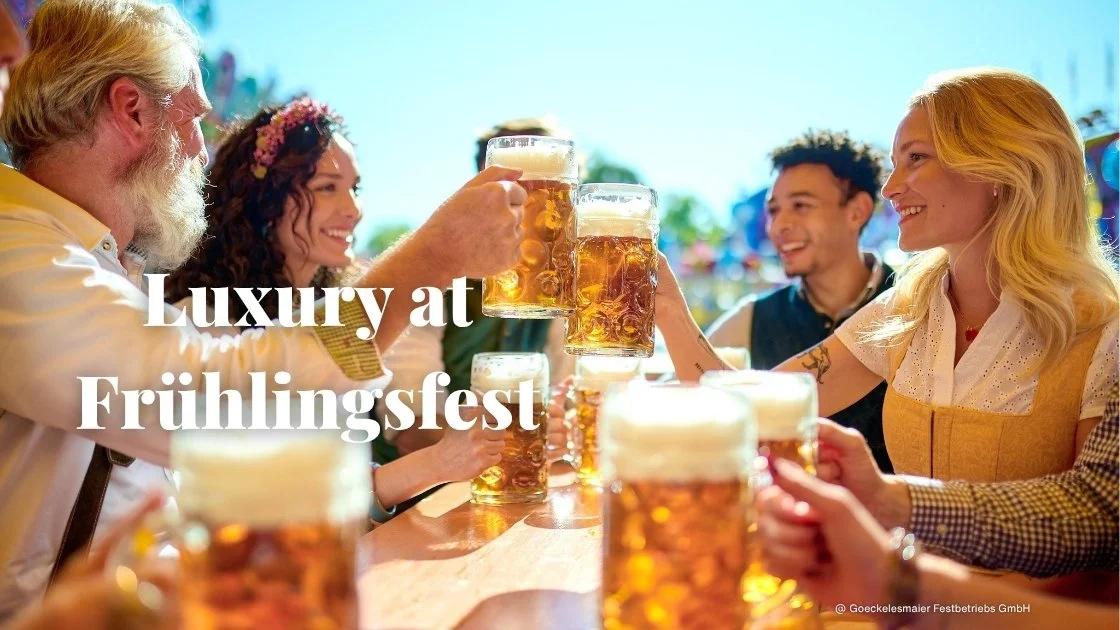
Enjoying a Maß in the sun.
Premium Beer Tents and Reservations
Neither Munich nor Stuttgart Frühlingsfest operators charge admission to the festival grounds. Early in the week, especially during the afternoon, it is possible to walk in off the street, find a table, and order beer and local specialties at your leisure.
In recent years, table reservations are essential for week-day evenings and always on weekends, often selling out months in advance. Guest select either the morning (11:00 or noon until 5pm) or evening (6pm to close at 11pm or midnight). Each fest table seats 10 people, five on each side. Each beer tent presents different offers. Some reservations require pre-paid food and beer vouchers, while others may offer the table reservation for a small fee per guest without a required food and beverage purchase (usually early in the week and morning sessions). The table reservation includes a wrist band, which is important for ease of access leaving and returning to the tent.
Tables near the stage (“Bühne”), where the live band performs, are usually the rowdiest. Many of the patrons are younger and drive the upbeat atmosphere.
Premium seats are offered on the wings in more decorative and elaborate private boxes and balconies. This is where you find members of higher society, celebrities, politicians, and corporate gatherings. The menus may be more elaborate, champagne and other wines will be offered besides beer, service is more personal and frequent, and some offer faster access to private restrooms.
Tent reservations are made directly with each tent operator (also known as a “showman”). Eat Drink Fun coordinates group reservations as part of the Custom Adventure service.
Maß prices in 2026 run approximately €14.50 ($16.95) across both cities. This is comparable to Oktoberfest, and worth every cent for a festival-specific beer brewed in quantities that ensure freshness.
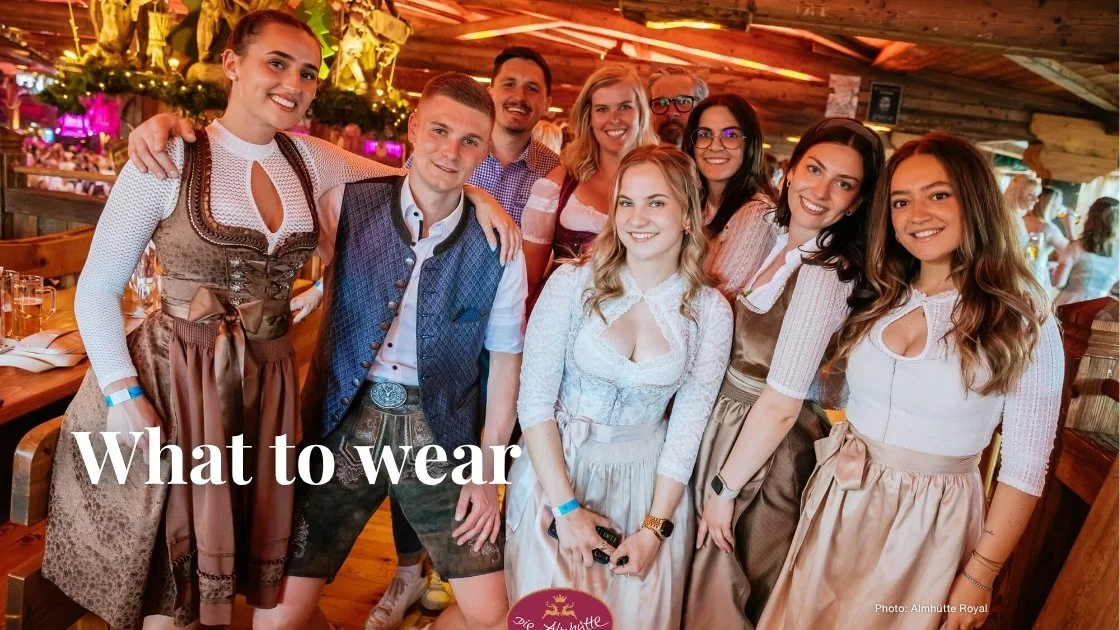
Patrons of Almhütte Royal in Tracht (traditional Dirndl and Lederhosen)
What to Wear? Tracht: Dirndl and Lederhosen Traditional Dress
Tracht, the traditional Bavarian and Swabian dress, is worn at both festivals and adds immeasurably to the atmosphere. Women wear the Dirndl: a fitted bodice, full skirt, and apron, with the apron bow tied to the right if the lady is spoken for, left side for the single ladies, and center for young girls and those who prefer to not be disturbed. If the bow is tied in the back, the lady is either a server/employee or a widow, traditionally.
Men wear Lederhosen: leather shorts or knee-length breeches, braces, a checked or linen shirt, and Haferl shoes. Good quality lederhosen are made of goat, and ultra premium lederhosen are made from deerskin.
Guests are not required to wear Tracht. However, visitors to any beer tent in southern Germany will have a far superior experience when properly attired. Traditional dress immediately puts you in the right spirit mentally. Purchasing high quality Tracht is also a sign of respect, it’s fun, and you feel as though you truly fit in.
Angermaier is Munich's most established Trachten specialist, with stores in Munich and Stuttgart, and a full online shop. Founded in 1948 and the largest traditional costume retailer in Munich, Angermaier stocks everything from entry-level festival sets to elaborately embroidered premium pieces. Over the years, Angermaier became the ultimate pop-culture Trachten house. They revolutionized the industry with high-profile collaborations, including a pompous line with designer Harald Glööckler and a trendy collection with Catherine Hummels.
Krüger is a very well-respected Trachten specialist in Stuttgart. Gerhard Krüger established the Krüger Dirndl Manufaktur over 60 years ago in Berchtesgaden, Bavaria, focusing on high-quality, authentic tailored traditional wear. The headquarters relocated to Wernau near Stuttgart in 2007, where it is currently operated by the next generation, Benjamin and Dominik Henne. They feature the "Original 1818 - Die Schwabentracht" collection, an authentic regional costume honoring the Swabian heritage of the Stuttgart area. They also offer custom fan gear, such as the Stuttgarter Jung lederhosen tailored for VfB Stuttgart football fans.
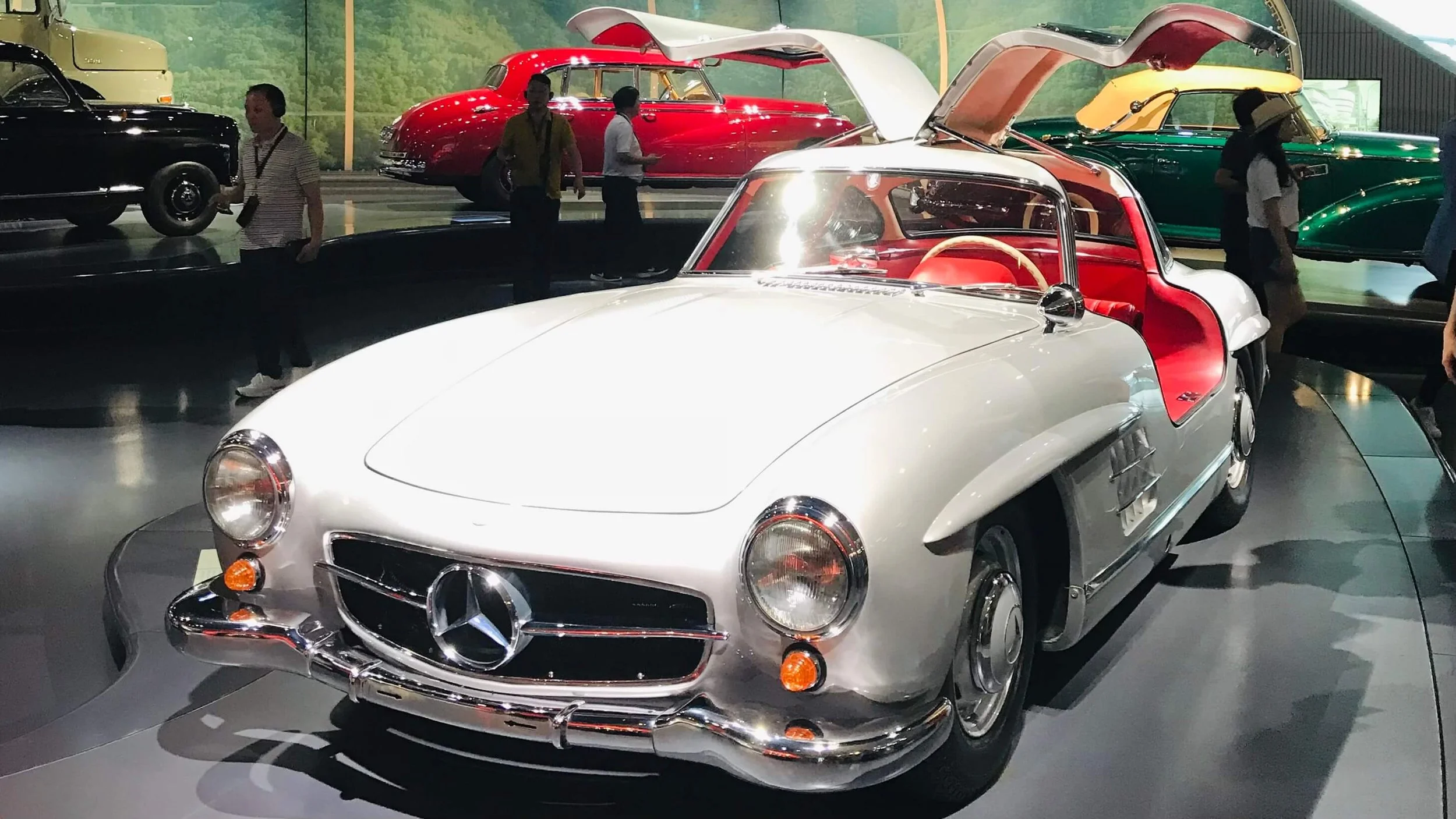
Mercedes Benz Museum in Stuttgart | the legendary 300 SL Gullwing (W198)
Cities for Car Lovers: Mercedes, Porsche, and BMW
If you enjoy luxury and performance German cars, the Frühlingsfest cities double as a pilgrimage circuit for automotive enthusiasts. Stuttgart is home to both theMercedes-Benz Museum, a spiral of glass and concrete housing more than 160 vehicles and 130-plus years of automotive history, open Tuesday to Sunday. The museum itself is a work of art, invoking Gugenheim vibes, and the descending helix layout is a powerful blend of German history with automotive history. Don’t miss the 1930s sport cars, 1950s 300SL Gullwing, the Pope mobile, and the Formula 1 cars.
ThePorsche Museum in Zuffenhausen, just north of Stuttgart, is a cantilevered architectural statement above Porscheplatz, with around 80 vehicles on permanent display. This is a must see for any Porsche enthusiast, from the world’s first electric car (existing before the combustion engine concept), to the latest models.
Both museums are easily accessible by public transit (U-Bahn and S-Bahn).
Munich is home to theBMW Welt and BMW Museum in the Olympic Quarter, adjacent to BMW's headquarters. It is a modernist complex where you can see production vehicles, concept cars, and motorsport history under one roof. For a guest spending time in both cities, visiting all three is a realistic two-day objective.
Munich Frühlingsfest | The Munich Spring Festival Overview
Munich's spring festival is often called the "kleine Wiesn" (the little Oktoberfest) and the comparison is apt in geography and spirit. The Theresienwiese (Theresa’s Meadow), the same 42-hectare grounds used for Oktoberfest since 1810, hosts a tighter, more scaled-down event in spring. Starting in 2026, the Munich Frühlingsfest has been extended from two weeks to three. That extended window is genuinely useful for travelers: it creates flexibility around a long ski week that ends in late April, a longer Bavaria itinerary that builds through early May, or the opportunity to visit both spring beer festivals in Germany.
The Munich festival opens with a brewery parade and the ceremonial tapping of the first keg at 4 p.m. in the Festhalle Bayernland. Special events follow across the run: Bavaria's largest flea market (around 2,500 vendors, organized by the Bavarian Red Cross), a vintage car meet-up, and two fireworks displays on Friday evenings. Traditional Customs Day features Schuhplattler dancing, Goaßlschnalzen whip-cracking, and brass band performances from Munich and Bavarian groups.
Arrival, Hours of Operation, and Dates in Munich
Getting there
To get to the Theresienwiese in Munich using public transit, you can use the city's highly efficient MVV transport network (MVGO App). The festival grounds are located entirely within Fare Zone M (Munich City), meaning a standard city single ticket (€3.90) or a Zone M Day Ticket covers your entire trip.
Theresienwiese Station (U4 / U5 lines): This is the closest stop, taking you directly to the northern edge of the grounds. It is only 1 stop (1 minute) away from Munich Central Station (Hauptbahnhof). Trains run every 3 to 5 minutes.
Schwanthalerhöhe Station (U4 / U5 lines): Located 1 stop west of Theresienwiese, this is an excellent, less-crowded alternative that exits onto the western edge of the grounds.
Hackerbrücke Station (S1 through S8 lines): If you are arriving from further outside the city or directly from the Munich Airport (MUC) via the S1 or S8, alight here. It is a scenic, 10-minute walk south across the bridge to the main entrance. During major events, trains on this core line run almost every minute.
Bus or street tram? Hermann-Lingg-Straße Stop (Tram Lines 18, 19, 29): Located just 300 meters directly north of the grounds. Alter Messeplatz / Georg-Hirth-Platz Stops (Bus Lines 53, 58, 62, 134): These bus routes stop along the northern and eastern borders of the plaza.
Germany uses an honor system for public transportation - there are no turnstiles. If you are caught without a valid ticket, the fines are paid on the spot and they are steep (about $100 per violator).
Opening hours
Monday to Friday 11 a.m. to 11 p.m., weekends from 10 a.m. Last drinks at 10:30 p.m.
Dates
2027 dates are still unpublished.
Munich Beer Tents | The Fun
Munich's Frühlingsfest operates two (2) large tents. By Oktoberfest standards, which offers 17 tents, some holding 10,000 guests, this is intimate. It is also what makes the festival so navigable.
Festhalle Bayernland
The Festhalle Bayernland is the festival's centerpiece and largest tent, holding approximately 5,000 guests inside with additional beer garden seating. It pours exclusively Augustiner, Munich's oldest and most locally beloved brewery, established in 1328, and the brewery that consistently tops informal Maß-quality surveys among Munich locals. The tent's interior runs wall-to-wall Bavarian kitsch in blue and white: painted murals of Alpine scenes, carved wooden details, and the kind of bench seating that makes strangers into friends by the second round. This is where the opening keg is tapped each April at 4 p.m., marking the ceremonial start of Munich's spring festival season.
Weekday lunch specials - e.g. a 1-liter beer (Maß) with a half chicken - run from around €14.80 making it among the best-value meals at any German folk festival. Reserve a table for weekend evenings directly through the tent website. Walk-ins are realistic on weekday afternoons.
Finally, Augustiner-Bräu is my favourite beer in Munich. A freshly brewed Augustiner is always worth the journey. You will not taste a better large volume brewery beer at any festival anywhere else on the planet.
Hippodrom Munich
The Hippodrom is the festival's second large tent, smaller than the Bayernland but reliably the livelier of the two as the evening progresses. It serves Spaten-Franziskaner, one of Munich's six main festival breweries. Frühlingsfest beer is a slightly higher alcohol lager brewed specifically for spring. On occasion guests may find the darker "Ur-Märzen", an amber that is aged over the summer for the Oktoberfest, but Märzen style beers are no longer the norm.
The Hippodrom runs hotter musically and tends to attract a slightly younger crowd. Main dishes run approximately €21 to €34. Weekday lunch offers reduced pricing on selected mains. Reservations through the tent's website.
The fairground surrounding both tents spans over 30 rides and 100 vendors: the Willenborg Ferris wheel at 50-plus meters with views across Munich, the Wilde Maus roller coaster, Top Spin, Flip Fly, bumper cars, carnival shooting and throwing galleries, a giant slide, and for the 2026 anniversary, the return of the Skyfall free-fall tower after a 20-year absence. Ride tickets run approximately €3 to €6. Family Day is every Tuesday from noon to 7 p.m. with discounted prices across all rides and stalls.
What to Eat at Munich's Spring Festival
Munich's festival food is Bavarian by default, and the canon is well-established:
Hendl - crispy rotisserie half chicken, ordered at the tent
Schweinshaxe - slow-roasted pork knuckle, ideally with Knödel and a dark sauce
Weißwurst - Munich's white veal sausage, consumed before noon with sweet mustard and a Weißbier; this is more of a rule, not a suggestion
Brezen - large, dark-salted soft pretzels, eaten with Obatzda cheese spread, and
Steckerlfisch - whole fish with proprietary herbal dry rub, grilled on a stick over open flame; it’s a Bavarian fairground specialty that should not be skipped
For dessert, Dampfnudeln - steamed sweet dumplings served with vanilla sauce or fruit compote. These are worth seeking at the food stalls between tent sessions.
Bring cash. Credit card and contactless payment acceptance at German festival stalls is more prevalent than ever, but it can still be inconsistent. Budget €100 to €150 per person for a full festival day including tent food and two to three rounds of beer.
What to Drink at Munich's Spring Festival
Both tents pour Frühlingsfestbier, a festival-specific lager brewed by their respective breweries. Augustiner at the Bayernland and Spaten at the Hippodrom each produce a spring batch distinct from their year-round lineup: slightly lighter in body than Oktoberfest Märzenbier, with a clean malt character and enough backbone to survive the transit from tap to table in a full liter Maß.
Augustiner still uses traditional wooden barrels (Holzfässer) for some pours, a detail that matters to any serious beer drinker, and increasingly rare at German festivals. Both tents also stock Radler (lager mixed with lemonade or sprite), Weißbier (wheat beer), and non-alcoholic drinks.
Where to Stay in Munich
The following are Ski Somm® selected recommendations for luxury and comfort:
Hotel Bayerischerhof - a legendary, family-run 5-star grand hotel located in the historic center of Munich. Originally commissioned by King Ludwig I in 1839, this opulent landmark blends deep history with contemporary luxury across 337 uniquely styled rooms and suites. The property functions as a premier destination for world leaders and celebrities, serving as a cultural hub featuring five gourmet restaurants (including the multi-Michelin-starred Atelier), six bars, a private theater and nightclub, and the expansive, four-story Blue Spa complete with a rooftop pool and panoramic views of the city.
Rosewood Munich - an ultra-luxury 5-star hotel occupying two meticulously restored landmark buildings in the heart of Munich's Old Town: the 19th-century former Bavarian State Bank headquarters and the 18th-century Palais Neuhaus-Preysing. Merging historic grandeur, complete with original vaulted ceilings, frescoes, and a grand staircase. With contemporary residential design, the hotel features 132 sophisticated rooms, suites, and exclusive multi-bedroom "houses". Guests can enjoy Alpine-inspired fine dining at Brasserie Cuvilliés, nightly live jazz and craft cocktails at Bar Montez, and a massive, two-story Asaya Spa.
Cannstatter Frühlingsfest | The Stuttgart Spring Festival Overview
Stuttgart's Frühlingsfest runs on the Cannstatter Wasen (Bad Cannstatt “meadow”) fest ground, a 35-hectare site on the Neckar River in Bad Cannstatt. These are the same grounds that host the fall Cannstatter Volksfest, Germany's second-largest beer festival after Oktoberfest.
The spring edition, first held in 1934, draws 1.5 to over 2 million visitors annually and carries the official designation of the world's largest spring folk festival. It is consistently underestimated by English-speaking travelers, who remain far more familiar with Munich as a beer city. The Schwabs should not be underestimated.
The Stuttgarter-Frühlingsfest runs every day and night for three consecutive weeks. Around 250 attractions are on site, including rides, stalls, food courts, a Krämermarkt with more than 50 vendors, and four large beer tents (twice the number in Munich). The Ferris wheel (Riesenrad Bellevue), roller coasters, bumper cars, a Freifallturm (free-fall tower), and the large Kettenflieger (chain swing ride) are fairground anchors. Family Day is every Wednesday with discounted ride prices. Entry is free.
Arrival, Opening Hours, and Dates in Stuttgart
Getting there
S-Bahn lines S1, S2, or S3 to Bad Cannstatt station, or U-Bahn lines U11 to Cannstatter Wasen. The U11 train deposits you directly at the entrance. Use the VVS app to load your ticket on your phone (VVS Mobile). As a reminder, Germany uses an honor system for public transportation - there are no turnstiles. If you are caught without a valid ticket, the fines are paid on the spot and they are steep (about $100 per violator).
Opening hours
Monday through Thursday 12 p.m. to 11 p.m.
Fridays 12 p.m. to midnight.
Saturdays 11 a.m. to midnight
Sundays 11 a.m. to 11 p.m.
Special days: 11 a.m. to midnight (e.g. opening day, May 1st).
Dates
7 April to 9 May 2027
Stuttgart Beer Tents | The Fun
The 2026 Frühlingsfest has four large beer tents. Note that the lineup has evolved in recent years: the current four are below.
Göckelesmaier
The Göckelesmaier is, by my honest assessment, the best tent at the Frühlingsfest and the one that most rewards a visit. This is a subjective opinion and fair minds disagree. Karl Maier has operated the family business since 1998. His father launched the original chicken grill on the Wasen in the 1950s and established Baden-Württemberg's first-ever rotisserie at a folk festival. The tent has since evolved into something genuinely refined: modern interior architecture, chandeliers, private boxes, chic cocktail bars, and a design sensibility that sets it apart from every generic festival tent in Germany.
The signature item is the Göckele, a crispy, golden rotisserie half chicken that is the tent's identity and its primary draw. Over three weeks, the Göckelesmaier moves approximately 25,000 of them. The tent holds over 2,500 guests inside, plus a 600-seat Biergarten for fair-weather afternoons. The beer provider is Dinkelacker, which delivers its signature Frühlingsfestbier, as well as other popular labels including Wulle, another lager, and Sanwald, a popular local Hefeweizen (wheat beer). Each evening, Karl Maier or a special guest throws Frisbees into the crowd, one for every year the tent has been open.
I conducted an in-depth interview with Karl Maier for the Eat Drink Fun podcast in 2021, covering the Göckelesmaier's history, design philosophy, and the culture of the Stuttgart festival season. Listen to Episode 7 here.
Weekday lunch specials run Monday to Friday, 12 p.m. to 3 p.m.: a half chicken or a Maß of Dinkelacker beer for €9.90, or the daily changing special for €11.90.
Beim Benz
Beim Benz — "Das Hofbräu Zelt" — is the tent formerly known as Grandl's Hofbräu Zelt. Festival host Marcel Benz took over in 2022 and rebranded under his own name, maintaining the same ownership while building a new identity around regional culinary integrity. In 2024, Beim Benz became the first festival tent in Baden-Württemberg to earn the "Schmeck den Süden" quality seal, awarded for sourcing more than 80% of ingredients from the region.
The tent's centerpiece is a 360-degree central stage. Artists perform in the round, giving every seat in the house a front-row sightline. The beer is Stuttgarter Hofbräu, poured as the Frühlingsfestbier brewed specifically for the festival season. Private boxes, a dedicated Beim Benz Bar, and the tent's regional food menu — including the dish roster behind the "Schmeck den Süden" designation — make this a strong choice for guests who want substance alongside the party atmosphere.
The Benz Deal: Sunday to Wednesday, one free beer per person with every table reservation (minimum order: one Maß and a half chicken). Worth booking.
Wasenwirt
Zum Wasenwirt is the Frühlingsfest's declared party tent, the venue where the programming runs hardest and the DJs stay latest. House band Die Grafenberger anchors the musical schedule alongside rotating top DJs. Special events include Wasen parties, SparBier promotion nights, and Nights of the Students. It is the tent to choose when the priority is dancing on benches rather than a refined dinner.
Beer: Stuttgarter Hofbräu Frühlingsfestbier, €14.40 per Maß in 2026. Food runs from grilled chicken and tent classics to daily changing specials at €9.80 on weekday lunchtimes. Reservations through wasenwirt.de.
Almhütte Royal
The Almhütte Royal is the newest addition to the Frühlingsfest tent lineup and one of the most architecturally distinctive. It is a full-scale alpine chalet constructed on the Wasen, complete with a large central nave, gallery seating on the second floor, and interior wooden detailing throughout. Run by Wasen show-woman Nina Renoldi, it is the evolved successor to the Königsalm and to the older Almhüttendorf format at the Volksfest, brought forward with the "Royal" designation as a larger, more elaborate version.
The Almhütte Royal is the most immediately familiar tent for guests arriving directly from the Tirol ski season. The architecture, the Tyrolean food references, and the alpine aesthetic bridge the slope-to-stein transition with uncommon directness. It is a natural first stop on the afternoon you arrive from the Alps.
What to Eat at Stuttgart's Spring Festival
Stuttgart's festival food runs on Swabian foundations, which distinguish it meaningfully from Munich.
The Göckele (rotisserie chicken) is the Frühlingsfest's calling card and should be eaten at the Göckelesmaier.
The Käsespätzle - Baden-Württemberg's signature egg noodle dish finished with melted mountain cheese and crispy fried onions. It’s almost mandatory.
Maultaschen, the large Swabian pasta pockets (like ravioli) filled with minced meat, spinach, and bread, served either in broth or pan-fried in butter with egg. It’s a dish most visitors discover here and remember forever.
Schweinshaxe, Weißwurst, and the full range of Bavarian-adjacent sausages are available at all tents.
The Almhütte Royal covers Tyrolean territory with Germknödel — sweet steamed dumplings filled with plum jam and finished with poppy seed butter — which appear on the menu alongside the more standard festival fare.
The Beim Benz menu, with its regional sourcing credential, offers one of the most curated food program on the Wasen. Weekday lunch specials at both Beim Benz and the Wasenwirt are consistently the best value on site.
Budget similarly to Munich: €100 to €150 per person for a full day. Carry cash as a backup as contactless payment is not guaranteed.
What to Drink at Stuttgart's Spring Festival
Stuttgart's festival brewery landscape is anchored by Stuttgarter Hofbräu, which produces the Frühlingsfestbier served at the Almhütte Royal, Beim Benz, and Wasenwirt. It’s a 5.5% ABV lager brewed specifically for the Frühlingsfest and Volksfest seasons, distinct from the year-round lineup. It is a clean, well-attenuated festival lager, lighter in color than the Märzen produced traditionally for fall beer festivals.
At the Göckelesmaier, the beer is Dinkelacker Frühlingsfestbier. Dinkelacker is a Stuttgart-based independent brewery founded in 1888 and still family-owned, producing a festival-specific batch for the Wasen that is not available elsewhere. The Hefeweizen option at the Göckelesmaier comes from Sanwald, Dinkelacker's wheat beer label.
Stuttgart's tents also carry full cocktail bars, champagne, wine, and spirits. The full-bar format is more prevalent in Stuttgart than at Munich's Frühlingsfest, and less judgment attaches to ordering something other than a Maß. Stuttgart is also a wine region, unlike Munich. The locals appreciate great local varieties - like Lemberger and Riesling, but one can find top international producers as well.
Where to Stay in Stuttgart
The following are Ski Somm® selected recommendations for luxury and comfort:
Hotel Zur Weinsteige - The perfect location if you like comfort, wine, and local ambiance. It also has an exceptional fine dining restaurant with one Michelin star.
EmiLu Design Hotel - Modern, stylish, and luxurious. Set within the central pedestrian zone of Stuttgart, the city is at your doorstep. The fest is a quick train ride away.
Althoff Hotel am Schlossgarten (temporary closed for renovation) - Formerly the poshest hotel in Stuttgart, also supporting a one Michelin star restaurant, this property is currently being refitted under the Althof Collection of hotels. We look forward to its reopening.
Stuttgart vs. Munich: Which Spring Festival Is Better?
There is no wrong answer, and the itinerary that covers both cities is the correct one for guests with a week to spare. But the festivals are genuinely different in character, and understanding the distinction helps you plan.
If you have two weeks to relax, the first week can be spent on skis in Tirol, enjoying the late season closing parties in Ischgl, Sölden, or other high elevation resorts. The second week can be split in southern Germany, enjoying the best of Munich and Stuttgart. If you live to smile and you thrive in an energetic festival atmosphere, these two weeks could be the best of your life. It’s nice to know it’s an option every spring.
Munich Springfest vs. Oktoberfest Differences
Munich's Frühlingsfest and Oktoberfest share the same grounds, the same beer, and the same brass-band and live fest music soundtrack. But the differences are consequential.
First, Munich’s Spring Festival offers only two beer tents - it is markedly smaller than Oktoberfest. Oktoberfest offers 17 tents and draws around six million visitors. The Munich Frühlingsfest draws 1.2 million.
One similarity: the Munich Frühlingsfest is now also three weeks long. Prior to 2026, Munich’s spring beer festival was only two weeks long. It seems the Bavarians were slightly jealous of the success of their Swabian neighbors in the west, where Stuttgart’s Frühlingsfest is always a full three weeks.
Second, crowd composition also differs. Oktoberfest runs at 60-plus percent international visitors in peak weeks; Frühlingsfest is predominantly local and regional. Table access is generally easier. Walk-in seating on weekday afternoons is entirely realistic at Frühlingsfest. Beer prices are comparable. The atmosphere is warmer, less transactional, and more reflective of how Munich residents actually use the Theresienwiese when the international spotlight is off.
If Oktoberfest overwhelmed you, or if you've always wanted to experience Munich's festival culture without the September crush, the Frühlingsfest is the version that delivers the genuine article at a human scale.
Stuttgart Frühlingsfest — Refined, Elegant, Beautiful, & Fun
Stuttgart's festival carries none of Munich's global name recognition and all of Munich's essential pleasures, plus a few it has no equivalent for. The Göckelesmaier is a better individual tent than either Munich option. The food, specifically the Swabian dishes, are more distinctive.
The city itself, while less tourist-facing than Munich, rewards exploration: two world-class automotive museums, the Wilhelma botanical garden, the Schlossplatz and Alte Kanzlei for lunch, and a wine region (the Württemberg Weinstraße) that produces some of Germany's finest Lemberger, Pinot Noir, and Riesling within 10 kilometers of the Wasen.
Stuttgart in late April is also less crowded than Munich at any point in the festival calendar. Table reservations are more accessible, accommodation is easier to secure, and the atmosphere inside the tents carries a local character that festival tourism in Munich increasingly struggles to preserve. The Frühlingsfest here is, to borrow a useful comparison, what Oktoberfest was before it became Oktoberfest.
A Cultural Analogy to State Fairs
These two beer festivals may be viewed as Germany’s equivalent to state fairs in the United States. The focus is on regional cultural appreciation through indigenous food, beverages, and fun activities for the family. From roller coasters, to games of strength and skill, to large concert venues playing popular music. The twist is that the people of Baden-Württemburg and Bavaria dress up in beautiful traditional clothing and hoist much larger, more delicious beers in tuetonically-engineered “tents” that host 5,000 or more people.
Watch the Festival Highlights
Go inside the tents and cover the essential information you need to plan your own Frühlingsfest visit. From slopes to steins, powder to prost, Alps to ales, and mountains to Maß.
Experience Germany Stress-Free with EDF Custom Adventures
The Frühlingsfest is one of the most enjoyable and least-planned events on the European calendar for English-speaking travelers. It is also one of the most straightforward to get right with the correct guidance: the right tent, the right table, the right timing relative to a ski week, and a route that connects Tirol's closing celebrations to southern Germany's spring season without wasted days or missed reservations.
EDF's Custom Adventure is built precisely for this kind of itinerary. We plan the full show, from end-of-season skiing at Ischgl or Sölden through the Frühlingsfest in Stuttgart and Munich, with insider access, tent reservations, accommodation recommendations, and a culinary map of both cities.
Start planning your Custom Adventure at eatdrinkfun.com/book-a-consultation.
Joint the funletter: https://funletter.eatdrinkfun.com/
Eat well, drink better, and have fun!